
Amplio Highlights
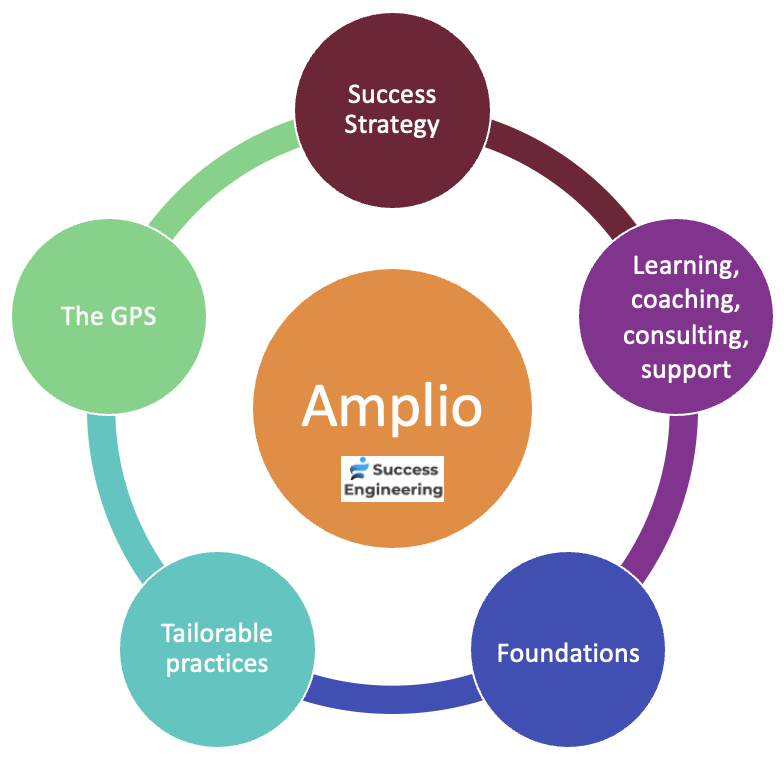
Components of the Amplio System

It is not a framework but a way to design how to create value. It takes a value by design approach.
The value by design approach enables you to design your system so that you can apply your resources (including your capabilities, time, and budget), efficiently, to create as much value as possible so that you meet your business objectives. Scope may change from its original statement to deal with competitive and constraining forces consistent with the stakeholders’ values, success criteria, and constraints. This, however, should be in line with the original objectives of any particular project.
Amplio can be likened to a combination of physics and engineering.
- It’s built on a foundation of understanding how the world of knowledge work works.
- It integrates design practices as well as predefined solutions so you can start how you like – from ground zero to custom to preset.
- It continuously improves.
Amplio’s Highlights
The following lists those aspects of Amplio not in the popular Agile frameworks or are only given lip service. Many of these concepts are in approaches based on Flow, Lean, and/or the Theory of Constraints. Because these are based on universal and scale-free practices, they can be applied anywhere. They can be used to create your own approach or to improve one you already have. Pre-defined configurations, that you can quickly choose based on your situation, are also available.
Foundations and tools
Amplio is based on an integration of theory and experience. This is the cornerstone of science. Experience tells us what works and doesn’t, while theory explains why. This enables us to step into the future with confidence of which actions will be beneficial. Providing practices without theory often leads to them being resisted. For more in depth discussion go here.
- Systems thinking. This provides the big picture as well as focusing our improvement initiatives on the workflow instead of our people.
- Value stream analysis. Value stream analysis can improve a system and provide insights to people who are used to focusing on local improvements.
- Inherent simplicity. An aspect of the Theory of Constraints is that only a few elements can explain the causes and effects in a complex system.
- Human-centered development. It is critical to understand how people listen, react, and resist. Without this understanding, improvement efforts are doomed to fail because they are not accepted.
What to build
Changing how people work is important. But if you merely cut down the size of your releases into smaller chunks, any process will improve. Step one is to determine what is important. Then figure out how to create it even more efficiently.
- Quickest valuable releases. Focusing on the quickest valuable release is essential. The generic terms of MVP and minimal epics do not create the clarity needed for alignment.
- Requirements by Objectives. While we can’t see all of the details of the functions (outputs) and benefits (outcomes) at the start of a project. We should be able to have clarity on what the objectives are with the details coming later.
- Clarity on the role of the MVP. The MVP term has been bandied about in so many different ways that it has lost its ability to help align people. Amplio uses Eric Ries’ use of the MVP as a vehicle to challenge our assumptions about the entirety of the product we are considering building.
- Shift in perspective. Software is notoriously difficult to use. The core reason is that most developers focus on the system they are creating and then explaining it to the people using it. It needs to be created from the perspective of the stakeholders using it.
- Jobs to be done approach. This focuses on the jobs the consuming stakeholders are doing. It goes beyond solving problems and creates better ways of working.
Improving workflows
The focus needs to be on continuous learning and improving our workflows not on a framework we’ve adopted. Amplio’s combination of principles and patterns enables quick improvement in many ways. Integrating practices with principles sets up continuous learning.
- Selecting practices to implement by selecting from a list of capabilities that detail what useful practices are in the form of patterns as solutions to recurring problems in a context.
- Eliminating delays in your workflow to achieve quicker feedback in order to eliminate waste.
- Providing a holistic view to overcome silos and create alignment across the organization.
A critical aspect of Amplio is to integrate Edgar Schein’s observation that “We don’t think and talk about what we see, we see what we are able to think and talk about.” By providing theory and practices Amplio’s turns people’s attention on the work itself, not on following a framework which often has us miss easy opportunities for improvement.
Getting started
How to get started is a critical decision. It should be obvious that this requires a diagnosis of the situation before starting. Unfortunately, no Agile framework provides for this. Their focus is on being simple. But “simple” should mean “simple for those starting”, not simply designed but difficult to implement.
To be “simple to use” requires being:
- Fit for purpose. Otherwise, it will be difficult to adopt.
- Understandable. Otherwise, it will be rejected.
- The right amount of change. Too little will lose momentum. Too much will overwhelm people.
- The right scope. Trying to change things without proper backing usually fails.
- The right level of skills. Teaching people new skills beyond their capability leads to frustration and resistance.
To do this Amplio provides:
- A way to diagnose your organization to see what the problems are.
- A way to create a roadmap for improvement.
- A way to implement a quick start based on a short analysis (hours for a team, a few days for an organization).
The Amplio Learning Kata
Amplio integrates Toyota Kata, an understanding of the domain being coached in, and how people learn based on Human-Centered Development. Understanding the domain enables the Kata coach to create a path to get to the target condition, understanding how people learn enables the coach to interact in an empathetic way that creates teamwork in improvement, and using a kata approach creates a straightforward path for the improvement.
Amplio provides thinking tools to guide the Amplio Kata coach. These include:
- Improved critical thinking. People tend to react to thoughts more than truly think about them.
- In-depth understanding of the Toyota Kata. Individual learning must be in simple steps that accelerate learning without resistance.
- Improving practices and an understanding of them using either Deming’s Plan-Do-Study-Act or Boyd’s Observe-Orient-Decide-Act loops. This goes well beyond mere “inspect and adapt” to fix problems and gets to the sources of them.
- A support system of PowerPoint presentations and virtual collaboration boards to help make decisions, teach, and collaborate.

Managing the workflow
Amplio defines roles in terms of the responsibilities people have to improve the workflow. It provides an integration of two styles of management, a redefinition of the business analyst, and the Amplio Kata Coach roles as defined above. Other roles are typically based on what works for the situation at hand.
- Lean Management and the Leader-Leader model of David Marquette. Lean management has managers focusing on the environment that people work within. The Leader-Leader model accelerates the path of people moving to more competent roles.
- Value discovery architect. In the ever competitive nature of today we must go beyond what stakeholders ask for. We must use our skills to see how to create new possibilities with innovation that will enhance their objectives. This is an enhancement of the business analyst role where the BA looks not just at what’s asked for, but what would truly be useful.
- Amplio Kata Coach. A guide who can navigate all levels of the organization is ideal – doing coaching, consulting, and mentoring when appropriate.
Transition Management
Change doesn’t just happen. It must be managed. This requires the proper teams to move it along. Amplio’s change management approach is based on an integration of William Bridge’s Managing Transitions and Lean Management. It can be adjusted to the culture of the organization.
How Amplio Was Created
Most approaches to improvement are based on a particular theory or the creators’ experience. Amplio has taken a different path.
Over a period of more than two decades, Al Shalloway, the primary creator of Amplio, had over 10,000 conversations at conferences, seminars and at clients discussing with practitioners and consultants on what works and what doesn’t. By using the theories of Flow, Lean, and the Theory of Constraints as a baseline, he created a system that is flexible enough to work essentially anywhere. Amplio represents the third generation of this – the first being what Net Objectives consultants used and later it was used for the Disciplined Agile Value Stream Consultant workshop. Amplio takes these even further.
Amplio University is the means by which you learn how to do this. It uses advanced learning methods to enable coverage of the full system in an economical manner.
The Amplio Success Strategy
Amplio starts with helping create clarity on what you are trying to do. Then it helps you identify what challenges you are having with its GPS and helps you create an improvement path which you tailor to your needs.
While starting with a diagnosis may appear obvious, popular frameworks start with pre-ordained practices. Amplio includes
Amplio’s improvement path consists of implementing proven, practices tailored to your context. This enables adopters to not have to re-invent the wheel.
Amplio also provides an extensive an extensive set of consulting, training, and support materials so people do not have to re-invent the wheel.
Amplio is based on a scientific approach to success management. These foundations provide guidance on how to choose the best practices for your situation.

Amplio’s Collaborative Engagements
It should be apparent that pre-ordained practices will not be fit-for-purpose all of the time. Yet our popular frameworks are built on them.
Frameworks need to be tailored.
If should also be apparent that people in an organization know more about it than any outside consultant will.
These two facts require us to combine the experience of an expert with the knowledge of those working in the organization.
This can be readily accomplished by using templates to decide the specifics of an adoption path.
Learn more about collaborative engagements: