
Amplio Organizational Improvement System
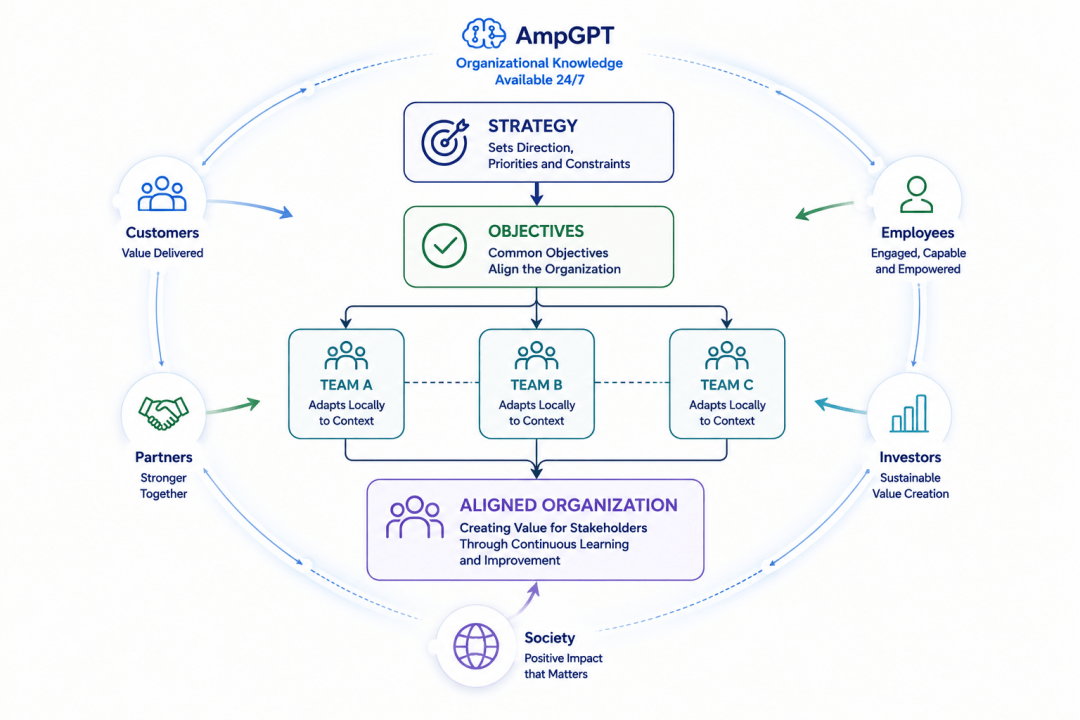
Implement Strategy Through Objectives, Not Compliance
Most organizations struggle to turn strategy into coordinated action. Standardizing how everyone works creates bureaucracy. Allowing every team to work differently creates misalignment.
The Amplio Organizational Improvement System (AOIS) provides a third option. Leaders establish common objectives, priorities, and constraints while teams adapt their implementation to fit their situation. This creates alignment across the organization without sacrificing effectiveness.
Supported by ACEs and AmpGPT, AOIS helps organizations develop internal capability, scale organizational knowledge, and continuously improve. The result is an organization that remains aligned, adaptable, and increasingly capable of creating value for all stakeholders.
As capability grows, organizations often discover they can create more value in less time while simultaneously improving quality, learning, and adaptability.
Amplio Organizational Improvement System (AOIS)
Implement Strategy Through Objectives, Not Compliance
Organizations often struggle to translate strategy into action.
Traditional approaches typically force a choice between standardizing how everyone works or allowing each team to determine its own approach. One creates bureaucracy. The other creates misalignment.
AOIS provides a third option.
Leadership establishes common objectives, priorities, constraints, and desired outcomes. Teams then implement those objectives in ways appropriate to their situation. This creates alignment across the organization while preserving the flexibility needed to achieve effective local results.

How AOIS Works
AOIS combines organizational alignment, capability development, adaptive practices, and AI-enabled learning into a single improvement system.
Rather than prescribing how teams must work, AOIS provides a common understanding of what must be achieved and the forces that must be attended to.
This enables people throughout the organization to make better decisions while remaining aligned to organizational objectives.

From Governance to Alignment
Most organizations rely heavily on governance.
Governance attempts to create alignment by controlling behavior.
AOIS creates alignment through understanding.
People understand:
- The organization’s objectives
- The desired outcomes
- The governing dynamics
- The constraints that matter
- The adaptive practices available
As understanding increases, the need for oversight decreases.
The result is an organization that becomes increasingly aligned without becoming increasingly bureaucratic.

A Collaborative Engagement Model
Most consulting engagements improve a small number of people.
AOIS is designed to improve the organization.
ACEs work directly with leadership, managers, product organizations, change agents, and teams while simultaneously developing internal capability.
The goal is not simply solving today’s problems.
The goal is helping the organization become capable of solving tomorrow’s problems.
Improvement activities are designed to transfer knowledge, build judgment, and create consultant independence.
Rather than creating dependence on outside experts, AOIS helps organizations develop their own internal capability.

Adaptive Practices Instead of Fixed Frameworks
Traditional frameworks define how people should work.
Adaptive practices define objectives and the forces that must be attended to while allowing implementation to vary according to context.
This enables:
- Consistency without rigidity
- Flexibility without chaos
- Alignment without bureaucracy
Teams can adapt while remaining aligned to organizational objectives.

Developing Capability While Creating Value
Many improvement efforts focus primarily on performance.
AOIS focuses on capability.
Performance matters.
But long-term performance depends upon an organization’s ability to continuously learn, adapt, and improve.
Organizations become stronger when their people become better at:
- Solving problems
- Making decisions
- Learning from experience
- Managing uncertainty
- Improving systems
Capability development is therefore integrated directly into everyday work rather than treated as a separate activity.

AmpGPT: Organizational Alignment at Scale
Historically, maintaining a common understanding across an organization has been difficult.
Knowledge becomes fragmented.
Experts become bottlenecks.
Teams interpret objectives differently.
Improvement efforts lose momentum.
AmpGPT changes this.
AmpGPT makes organizational knowledge, objectives, adaptive practices, diagnostics, and improvement guidance available throughout the organization 24 hours a day.
People receive support when they need it rather than waiting for consultants, coaches, managers, or training sessions.
The result is a continuously available capability development system that helps maintain alignment while accelerating learning.

The Components of AOIS
Organizational Diagnostics
Understand what is limiting performance.
Strategy Through Objectives
Align the organization around outcomes rather than implementations.
Adaptive Practices
Allow local adaptation while maintaining organizational coherence.
Capability Development
Increase the organization’s ability to continuously improve.
AmpGPT
Scale expertise, learning, and organizational understanding.
Continuous Improvement
Create organizations that become more capable over time.

The Goal
AOIS is designed to help organizations create value for stakeholders while simultaneously increasing the capability, agency, and effectiveness of the people within them.
The objective is not simply better execution.
The objective is creating organizations that become better at executing, learning, adapting, and improving over time.
That is the foundation of a humane organization.