
Books
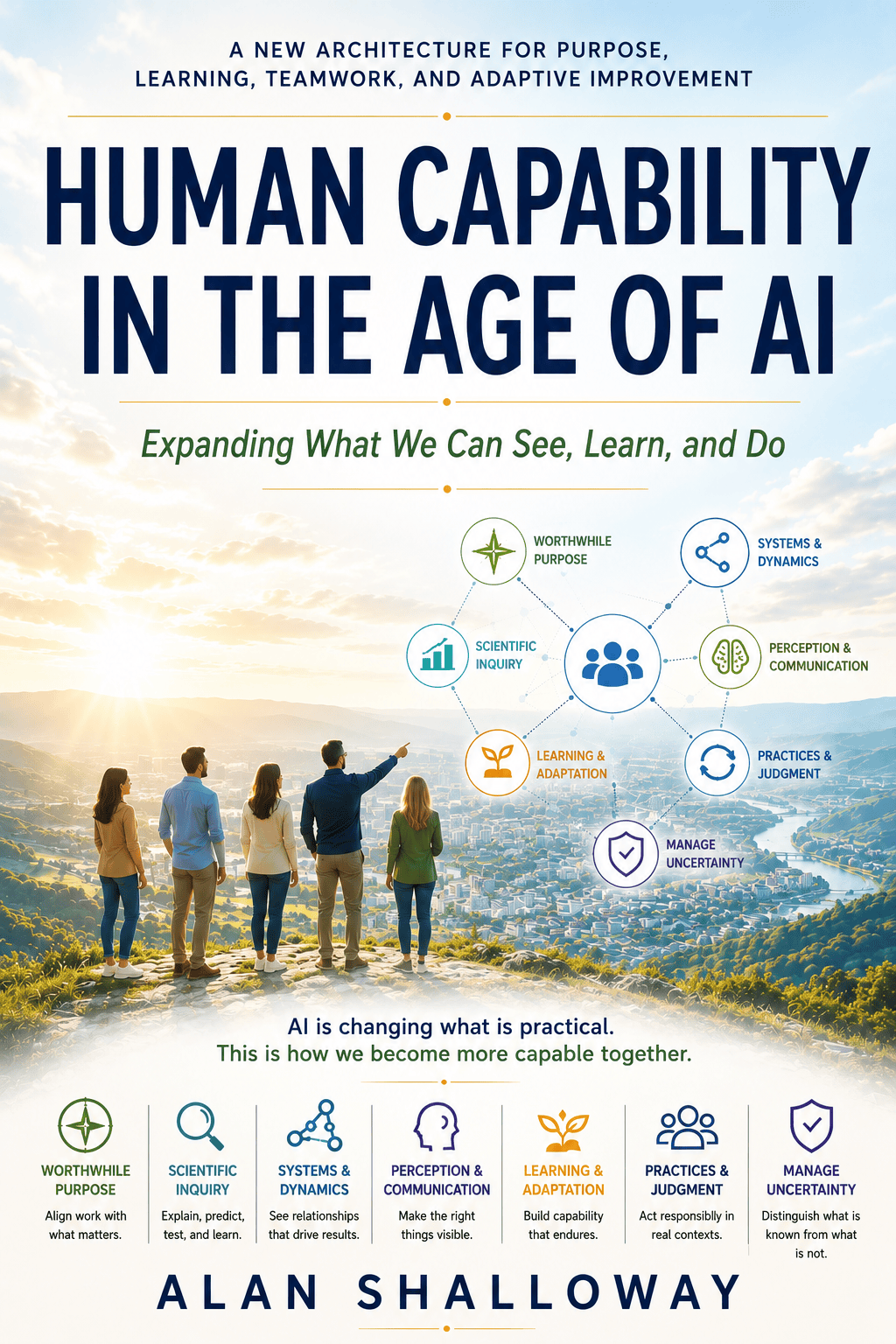
Human Capability in the Agile of AI
Human Capability in the Age of AI explores a simple but consequential idea: AI’s greatest opportunity is not merely to help us work faster, but to help us become more capable. The book examines why smart people and organizations so often struggle to see the systems they work within, understand what is producing the results they experience, adapt practices to their circumstances, manage uncertainty, and learn effectively from what happens. It then explores how AI changes what is possible—helping us see more, bring the right understanding to the moment of need, and develop capability through real work. This is not primarily a book about AI. It is about what becomes possible for people and organizations because AI now exists.
This book is currently online in beta. You can get access to it here.
Engage with Sonesis/AI on this and all of the Sonesis System
You can engage in interaction-driven learning with Sonesis by using AmpGPT as a thinking partner while you read and apply the material. It helps you explore concepts, surface what you may be missing, and take meaningful next steps in real time. This turns learning from something you consume into something you actively use. It can even role-play with you so you can practice coaching.
The Physics of Flow in Knowledge Work: Governing Dynamics for Product Development and Services
The Physics of Flow in Knowledge Work argues that while knowledge work is complex, it is not unknowable. Beneath the apparent turbulence of delays, shifting priorities, rework, and coordination breakdowns lie a small set of governing dynamics shaping outcomes. This book makes those dynamics visible. Drawing from Lean thinking, Reinertsen’s principles of flow, and Goldratt’s concept of inherent simplicity, it shows how causality continues to operate even in complex human systems — and how understanding that causality restores clarity and agency.
Rather than offering another framework, this book provides something more foundational: a disciplined way of seeing. When you understand the physics of flow, you can diagnose problems more quickly, tailor practices intelligently, shorten feedback loops, and move beyond mechanical implementation of methods. Complexity remains real — but it becomes navigable. This book is about revealing the structure within complexity so that better action becomes possible.
The concepts presented in this book are used by the other books in the Sonesis series.
You can watch an Sonesis Community of Practice session that discusses this book here.
Engage with Sonesis/AI on this and all of the Sonesis System
You can discuss Sonesis Physics of Flow with Sonesis/AI. This way you can learn what the physics of flow is, how it can help you, how you may not be consistent with it, or learn however you want. You’ll receive a governing-dynamics analysis grounded in cause and effect, inherent simplicity, value flow, learning cost, and systemic leverage—not surface advice or practice recommendations. Expect rigor, structural clarity, and examination of assumptions. This thread can also be used to ask and learn about the entire Sonesis system.


Sonesis Improvement Kata: Building Capability Through System, Perceptual, and Learning Dynamics
The Sonesis Improvement Kata is not about coaching Sonesis. It is about how to coach effectively in any environment by attending to three governing dynamics: system dynamics, cognitive dynamics, and learning dynamics. We call it the Sonesis Improvement Kata because Sonesis is grounded in these three—but the method itself is not tied to a framework. It is tied to how work actually flows, how people actually think, and how people actually learn.
Most coaching approaches focus on only one or two of these. They may address system issues without understanding how people interpret what they see. Or they may focus on mindset without addressing the structural constraints shaping behavior. Or they may introduce practices without enabling learning to take hold. Effective coaching requires attending to all three at the same time—seeing the system, understanding how people perceive and respond to it, and guiding learning in a way that builds real capability. Without this integration, improvement efforts stall or fail to sustain.
You can watch an Sonesis Community of Practice session that discusses this book here.
Engage with Sonesis/AI on this and all of the Sonesis System
You can engage in interaction-driven learning with Sonesis by using AmpGPT as a thinking partner while you read and apply the material. It helps you explore concepts, surface what you may be missing, and take meaningful next steps in real time. This turns learning from something you consume into something you actively use. It can even role-play with you so you can practice coaching.
Raising the Bar of What’s Possible
Overcoming the Learned Helplessness Plaguing Modern Organizations and Communities
Raising the Bar of What’s Possible is a book about a quiet but pervasive problem in modern organizations: learned helplessness. Capable people work hard, adopt new methods, attend training, and invest in improvement—yet results plateau. Over time, the question shifts from “What’s possible?” to “What’s realistic?” This book argues that the issue is not lack of effort or intelligence, but systems that teach people—through structure, incentives, and repeated experience—that meaningful change is unlikely. It exposes the forces that create this condition and restores the ability to see cause and effect beneath complexity.
Part I develops the foundation: how beliefs, fear, control, teaching practices, and system dynamics combine to narrow judgment and suppress initiative. It introduces the physics beneath improvement—flow, delay, variability, feedback—and shows why experience without theory reinforces limits rather than breaks them. Part II applies this lens first to Agile and product development, not to attack them, but to reveal where their implementation has unintentionally reinforced learned helplessness—and how to move beyond it. The goal of the book is not to prescribe a framework. It is to raise the bar of what readers believe is possible—and give them the clarity to act on it.
Engage with Sonesis/AI on this and all of the Sonesis System
You can engage in self-directed learning with Amplio by using Sonesis/AI as a thinking partner while you read and apply the material. It helps you explore concepts, surface what you may be missing, and take meaningful next steps in real time. This turns learning from something you consume into something you actively use.


Sonesis Development
Sonesis Development: The Path to Effective Lean-Agile Teams is a workbook that supports Success Engineering’s Sonesis Development Masterclass workshop designed for the business professional.
“Amplio” means “improve” in Latin. At Success Engineering, we believe that people need to continuously learn how to improve their methods of adding value to their customers. Success Engineering is creating ‘amplios’ for strategies and budgeting, for discovery (product management), and for development (team level). These can be used at all scales. An Amplio for SAFe will be made on demand. All of these are pragmatic approaches validated with real-world experience. The Sonesis Development Masterclass is our first offering. If you are not ready to fully engage this advanced workshop, please join our Sonesis Community of Practice (free) to both learn and get access to several useful virtual collaboration boards.
This book and the associated appendices are used in this workshop. Sonesis Development is a subset of the full Amplio approach
See other recommended books
This is a list of either extremely important books or very useful, little-known books.